Parking lots, churches and business property across the Miami Valley. The same sealer that goes on a driveway. Almost nothing else about the job is the same.
Same corner of the same lot.
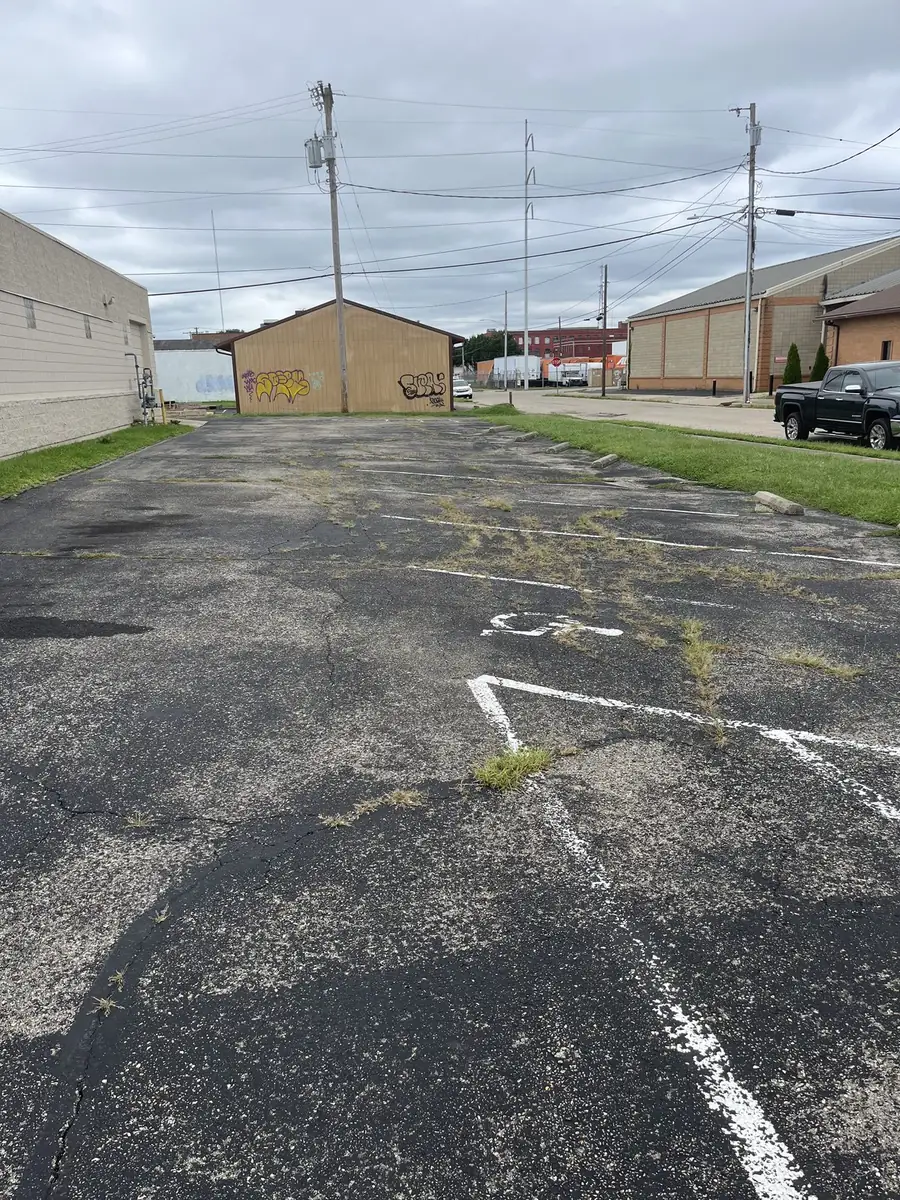
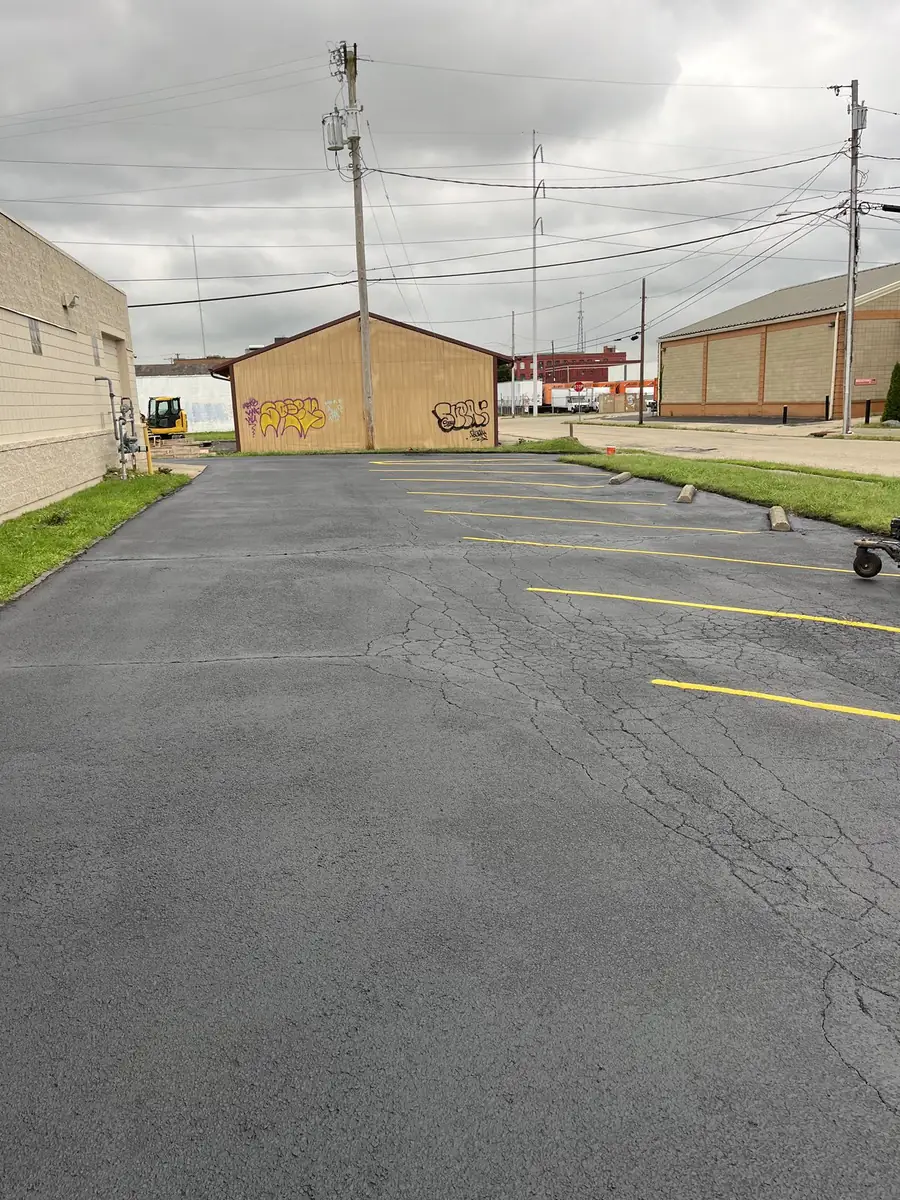
A driveway wears more or less all over. A lot wears in three places, and they are usually the three places nobody looks at: the drive lane, the turn at the entrance, and the ground around the dumpster.
Dayton sits where I-70 crosses I-75, so a lot of business property around here takes delivery trucks rather than only cars. That matters more than it sounds. A loaded trailer puts more weight through one axle than a full row of parked cars puts through an entire bay, and trailer landing gear and dumpster wheels concentrate all of it onto a few square inches of surface.
So the lanes and the pad get walked and judged separately from the parking bays. It is common for four fifths of a lot to be in good shape and the lane through the middle of it to need repair before any sealer is worth putting down.
Dayton averages about twelve inches of snow a year. The north east corner of the state gets roughly four times that, and lots up there fail from plow blades and heavy salting. That is not the failure mode here.
What the Miami Valley gets instead is a January that crosses the freezing point most days rather than staying under it. Upper thirties by mid afternoon, low twenties overnight, over and over. Every one of those crossings is water sitting in an open crack, freezing, expanding, levering the crack a fraction wider, then thawing and running deeper into the one it just made.
A lot with open cracks in November has measurably wider ones by March. That is the whole argument for filling before the coat goes on rather than sealing over the top and dealing with it next year.
Twenty four to forty eight hours before vehicles go back on it, weather depending. For most properties that is the entire problem, and the useful question is not how fast anybody works. It is when your lot is actually empty.
The answer is different for every property. A church is empty six days out of seven. A strip centre is never empty but can usually give up a third of itself at a time. An office park empties on Friday evening and nothing needs it again until Monday. We ask for your traffic pattern before quoting, because it changes the price: a lot done in one go costs less than the same lot done across three visits, and that belongs on the quote where you can see it rather than buried in a total.
The season here runs late April to about mid-October. A phased job booked in May gets a choice of weekends. The same job booked in October gets whatever the weather leaves you.
Sealer covers every marking on the lot, so striping is part of the job rather than an extra. Most lots go straight back the way they were, and that is usually right.
Two things are worth twenty minutes while the paint is off. If the lot has accessible spaces they should go back to the current specification rather than wherever the old paint happened to sit, access aisle and signage included. And if you have ever wished the lot held two more cars, the only cheap moment to find out whether it can is while there are no lines on it.
We will tell you what is on the ground and what changing it would take. We will not sign anything off as compliant, because that is not ours to sign.
Sealer is a surface coat. It takes the ultraviolet and it keeps water out of a surface that is still sound. It does not hold a failing lot together.
If the base has gone, and the sign of that is alligator cracking through the drive lane or potholes that come back in the same spots every spring, a coat of sealer buys you a dark lot for one season and nothing underneath it. That property needs patching or an overlay first. We will say so, and tell you roughly what that involves, even though it is not the work being quoted for.
Same answer for a lot that was sealed last season and only looks tired. Sealing on a two year cycle instead of a three year one is money leaving the building for no return.
Walked and measured on the property, never taken off an aerial photograph. Aerials miss the strip behind the building, the islands, and the loading area, which are exactly the parts that move the number.
Three lines come back. Sealing by area. Crack filling by the linear foot, measured rather than guessed, and on commercial asphalt it is often a bigger share of the total than owners expect. Striping counted per stall and per marking, so a like for like repaint and a relayout are not the same price.
Occasionally a fourth. A drive lane carrying truck traffic sometimes needs a second pass where the parking bays do not. That goes on as its own line, visible, so you can decide whether you want it rather than finding it inside a lump sum.
There is no charge to be measured and no obligation to book.
Strip retail, churches, office parks, apartment and condominium lots, self storage, medical and dental practices, and private roads run by an HOA. Anything from six stalls behind a shop up to a few acres. Kettering, Beavercreek, Centerville, Huber Heights, Miamisburg, Vandalia, Springboro, Fairborn and the rest of Montgomery and Greene County.
Send the address and roughly what the property is. You get a measured number back, split into sealing, crack filling and striping, and a way of scheduling it that does not shut you down.
